Leave: requests, approval and balances
Do this whenever someone takes leave. A leave request is entered (by payroll, or by the employee in self-service), approved by the right person, and then flows through to the timesheet and the pay run, where it comes off the balance.
About the screenshots
Screenshots are from Easy's demo company, Little Polynesian Café. Names, dates and hours are examples. The demo already has one leave request waiting (Pita Anana's), which is the one approved in step 3.
Before you start
Leave needs Full Payroll and the set-up from chapter 1: the leave types and their entitlements, and each employee's assigned approver on their record. Leave requests and balances are part of Full Payroll; Payroll Lite has no leave.
Step 1. See the requests
Payroll → Leave → Requests.
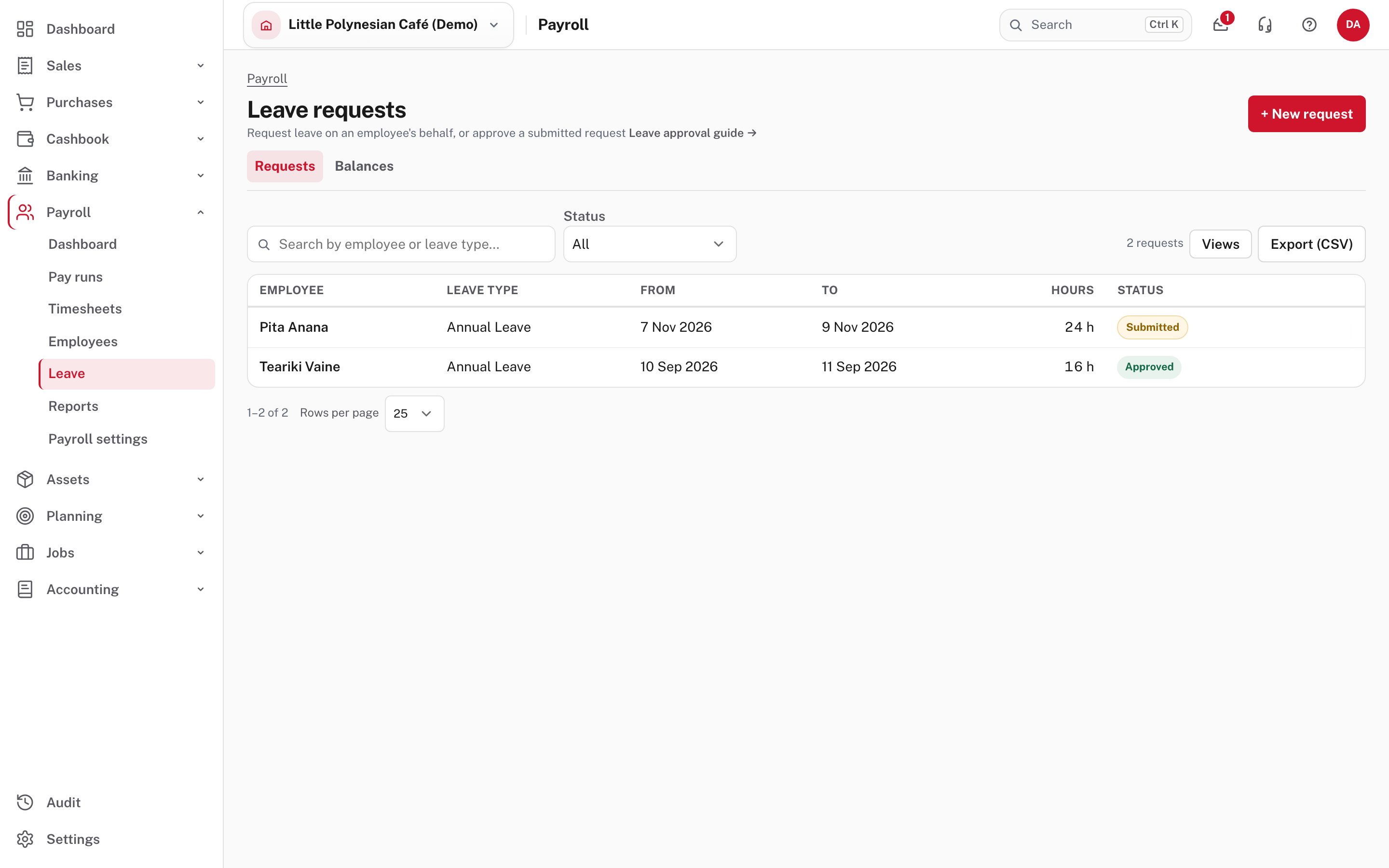
The list shows each request's employee, leave type, dates, hours and status. Search by employee or leave type, and filter by status: Draft, Submitted, Awaiting final approval, Approved, Declined or Cancelled. Balances (the tab beside it) shows everyone's leave in hours.
Step 2. Request leave
Choose + New request. You can request leave on an employee's behalf, and employees can request their own in self-service (For employees).
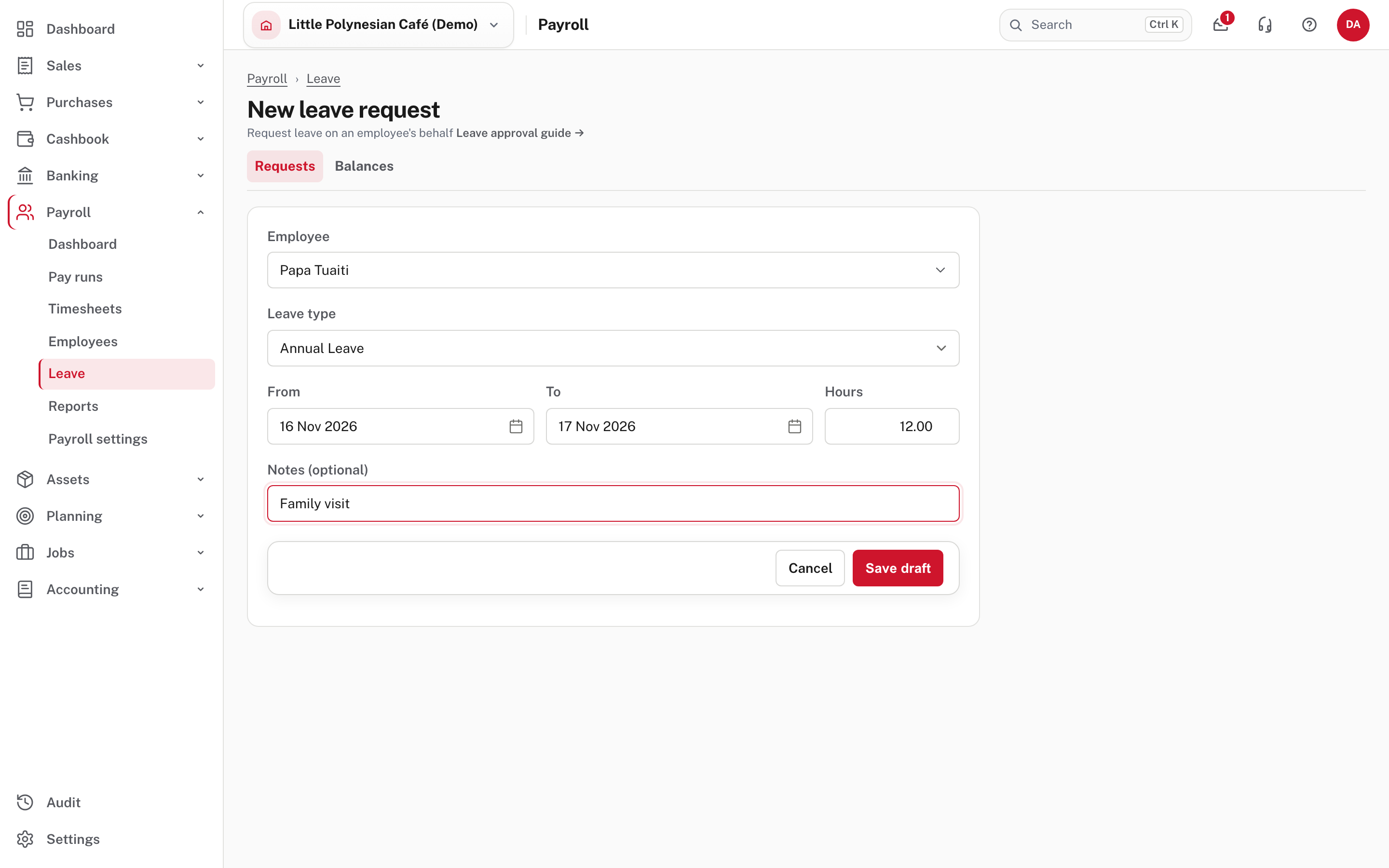
Choose the employee, the leave type, the From and To dates, and an optional note. The Hours box fills itself from the dates and the employee's work pattern: here Papa Tuaiti comes to 12 hours for two days, from his usual working days and hours. You can change it, for a half day or for a public holiday inside the range (the box does not take public holidays off). Once you type your own figure, the box stops following the dates. Easy refuses a request with zero hours.
Choose Save draft.
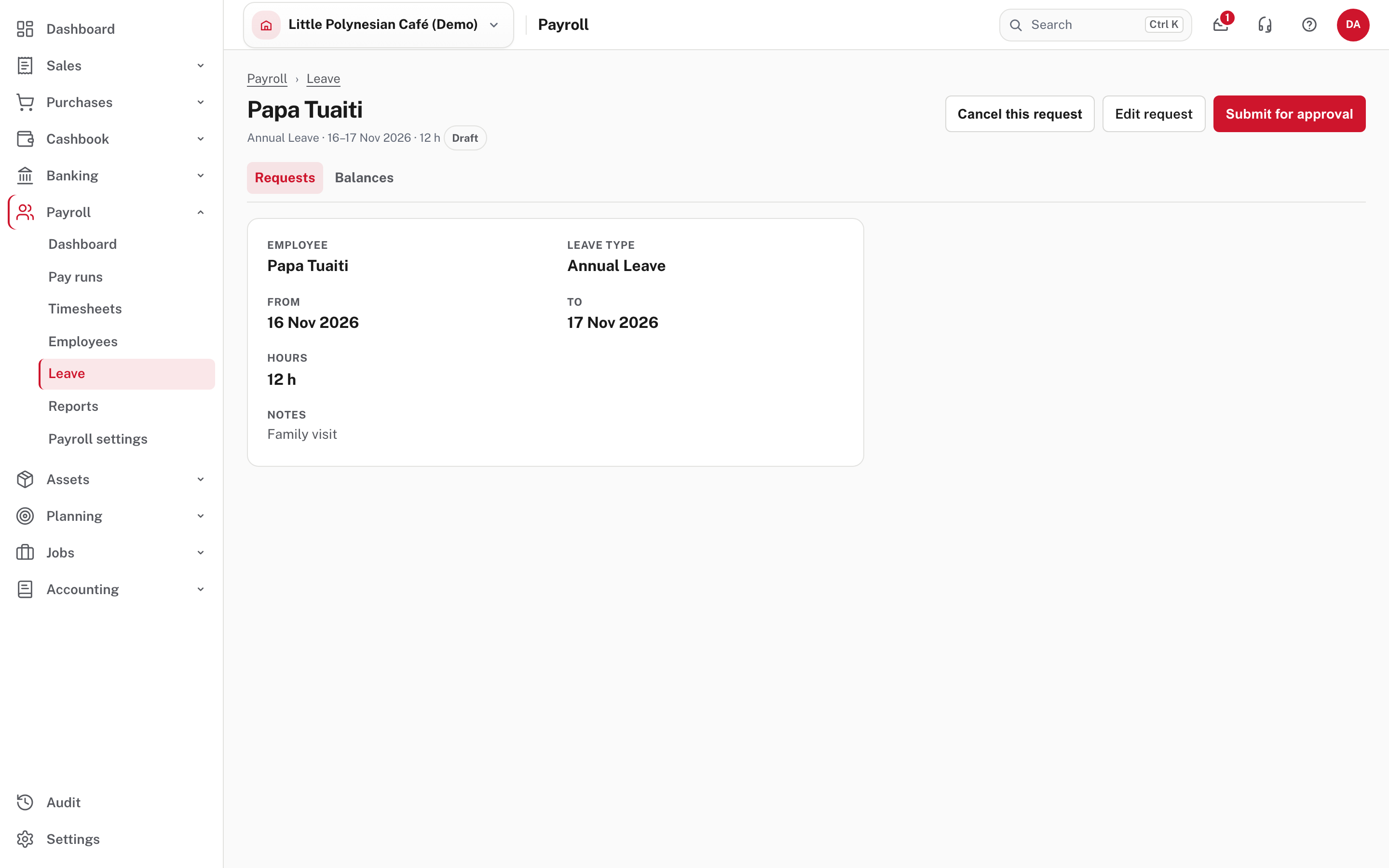
A draft can still be edited (Edit request) or cancelled. Choose Submit for approval.
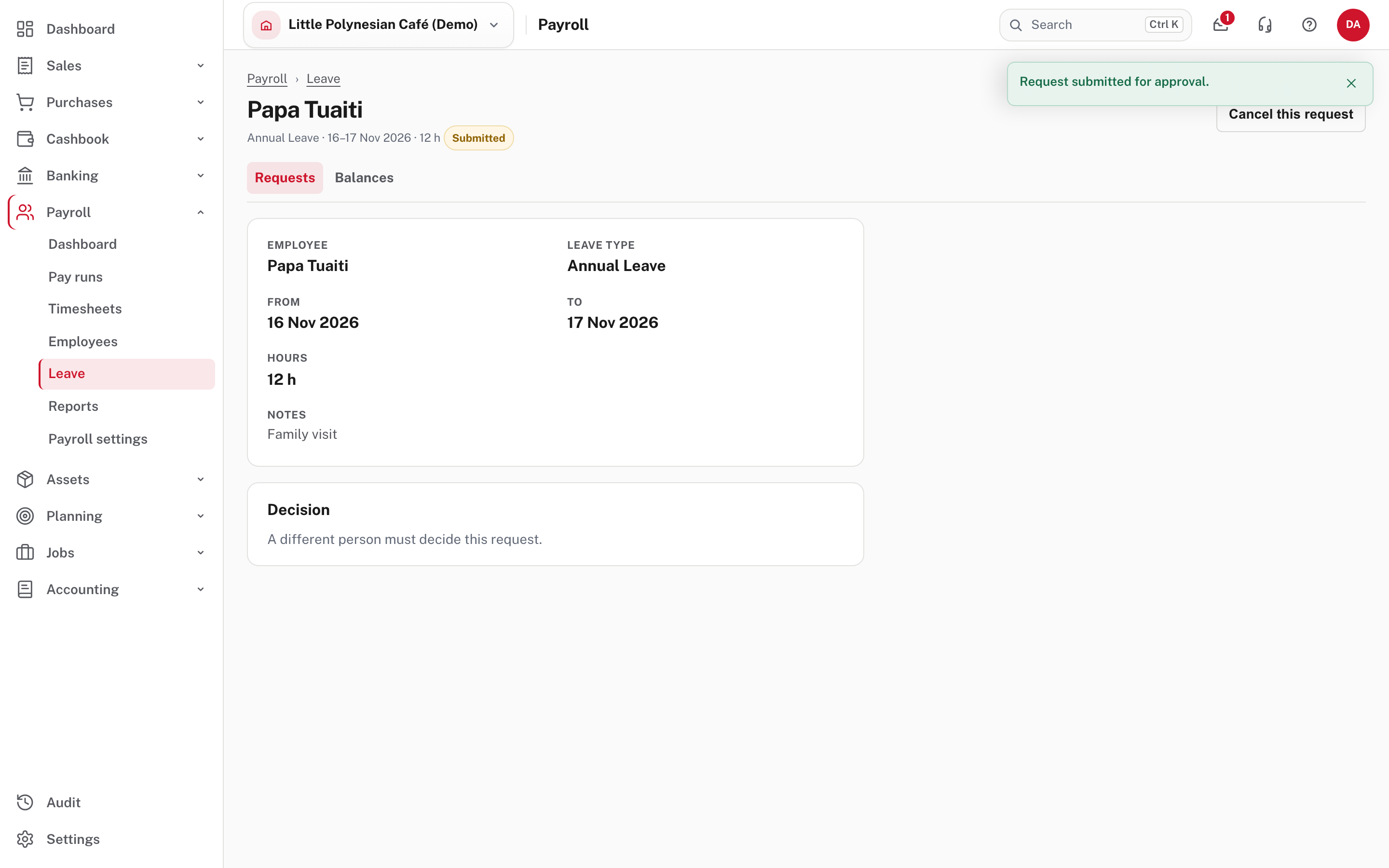
The request is now Submitted. Because the person who submitted it can never approve their own request, the Decision box says A different person must decide this request.
Step 3. Approve or decline
The employee's assigned approver gets the request (it appears under My actions in Mail). If the employee has no approver, anyone listed under Who can approve today on Payroll settings → Approvals may decide it. Open the request.
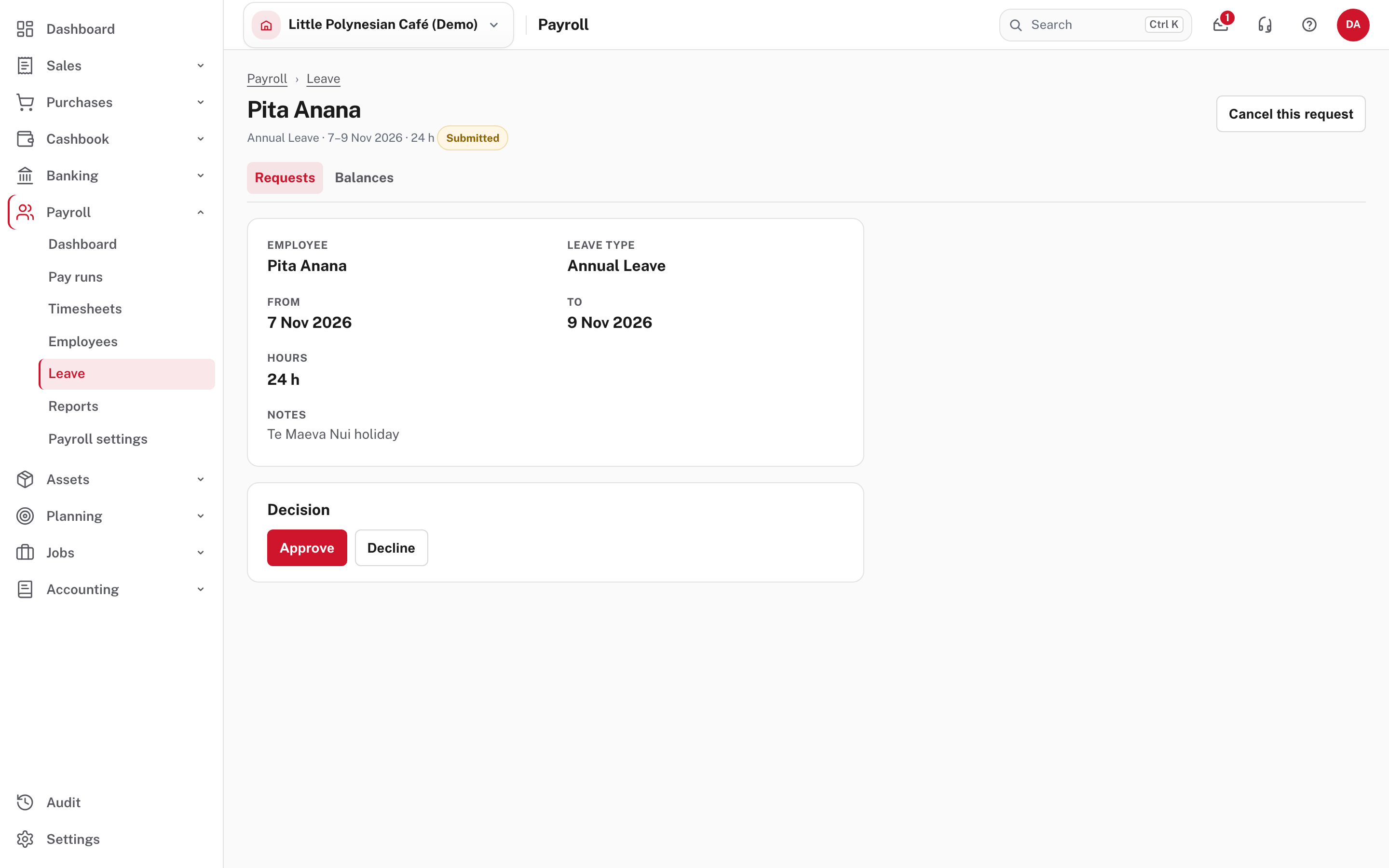
Choose Approve or Decline.
One approval by an eligible person is enough. (An older request that was already waiting for a second sign-off keeps its status, Awaiting final approval, and still goes to the approver it names.)
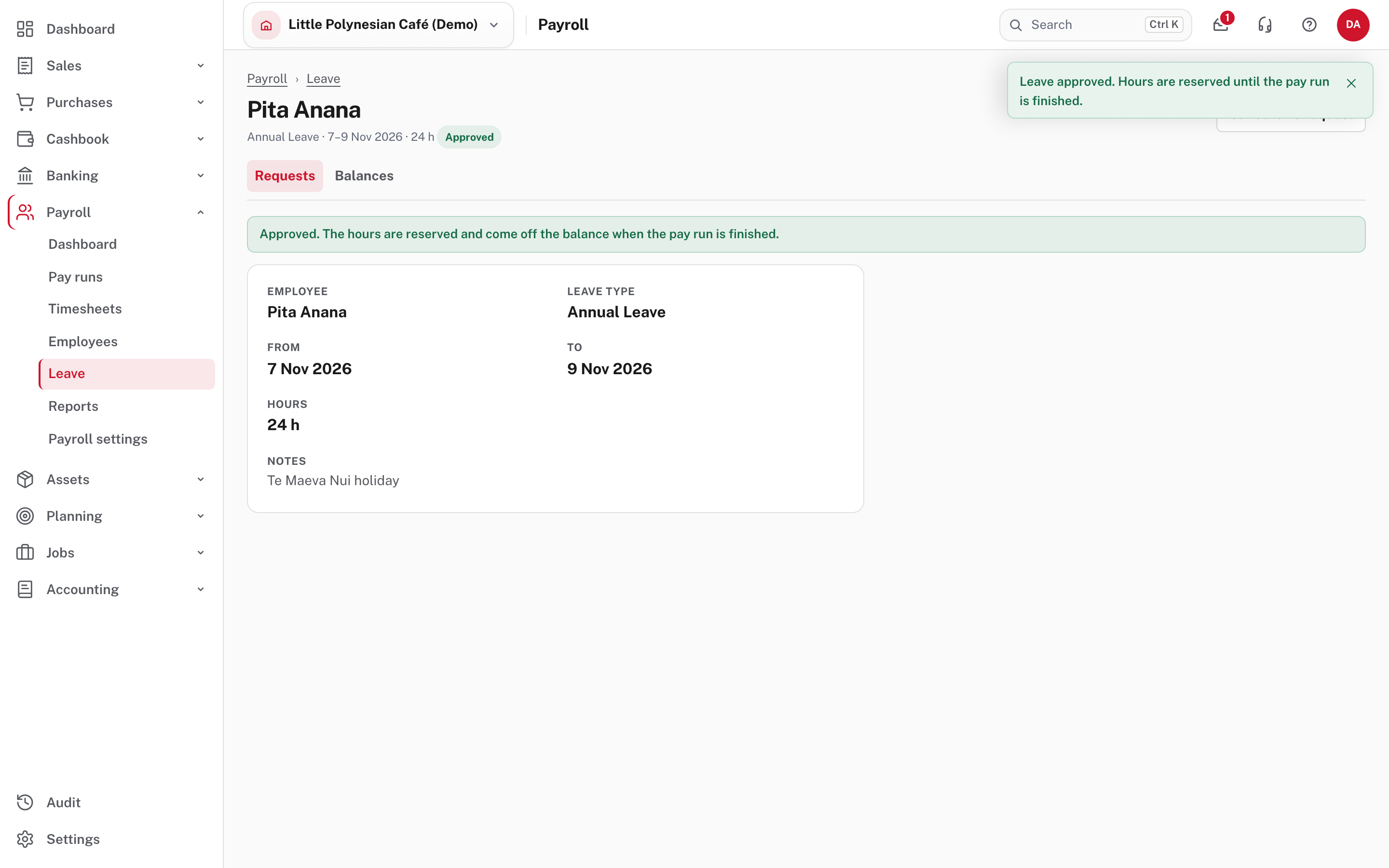
Easy says Leave approved. Hours are reserved until the pay run is finished. An approved request is final. Cancel this request is still offered while it can be cancelled.
More detail: How leave approval works.
Approved leave comes off the balance when the pay run is finished
Approving reserves the hours and puts them on the timesheet for that period. The balance only changes when the pay run for that period is finished (Leave balances and accrual); until then the employee's Used figure stays as it was, as on the Balances tab in step 5.
Step 4. Let it flow into the pay run
Payroll → Timesheets.
Approving puts the hours on the employee's timesheet for the period the leave falls in. In the demo, Pita Anana's approved 24 hours appear on her draft timesheet for 28 October to 10 November.
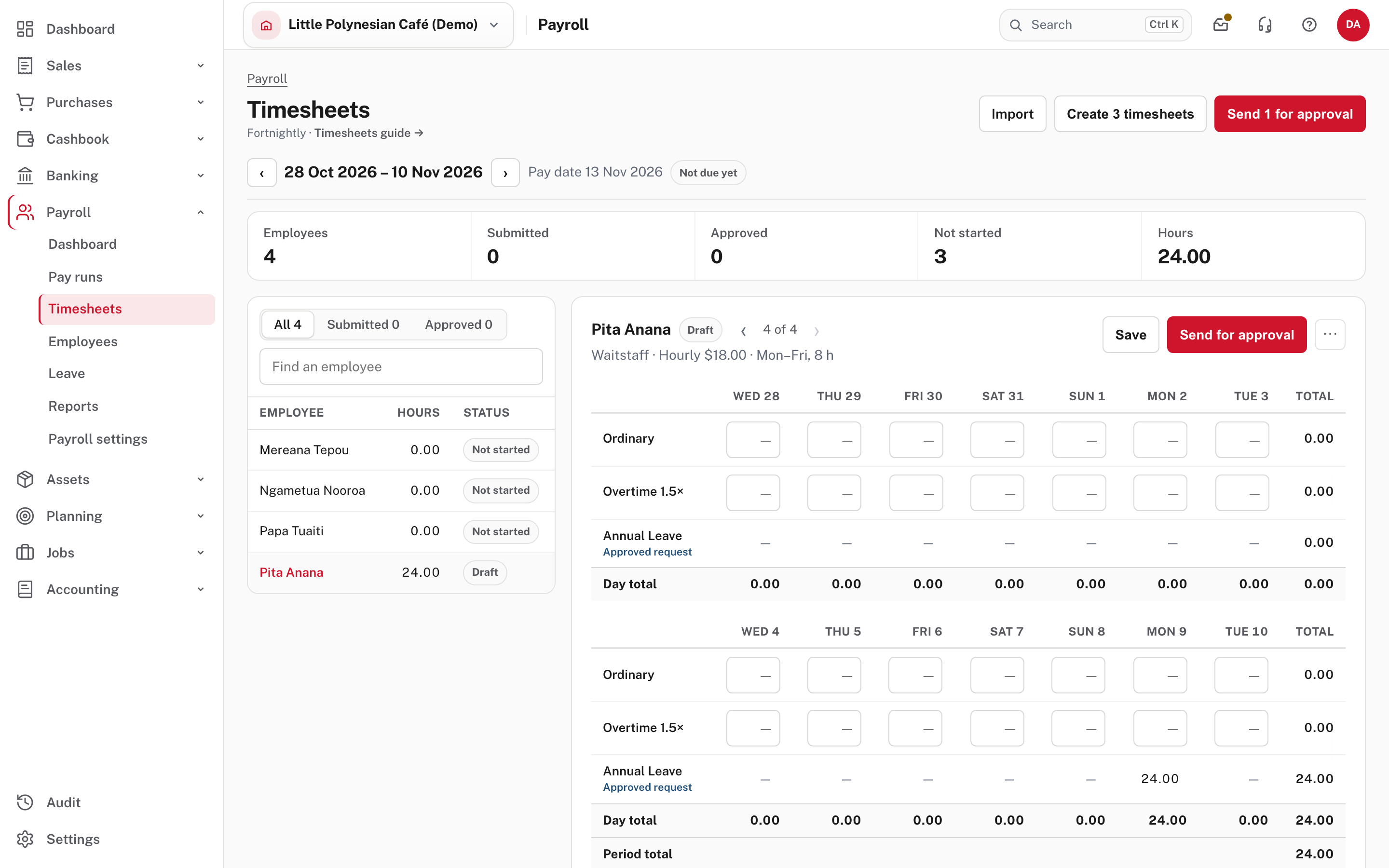
Each kind of leave has its own row, so every box lines up under its day. Leave from an approved request arrives filled in, as figures rather than boxes, with an Approved request link to the request under the row's name; to change those hours, change the leave request. The leave is paid at the employee's ordinary rate in the pay run (Run a pay period, step 1). When the pay run is finished, the leave comes off the balance of the year the leave day falls in.
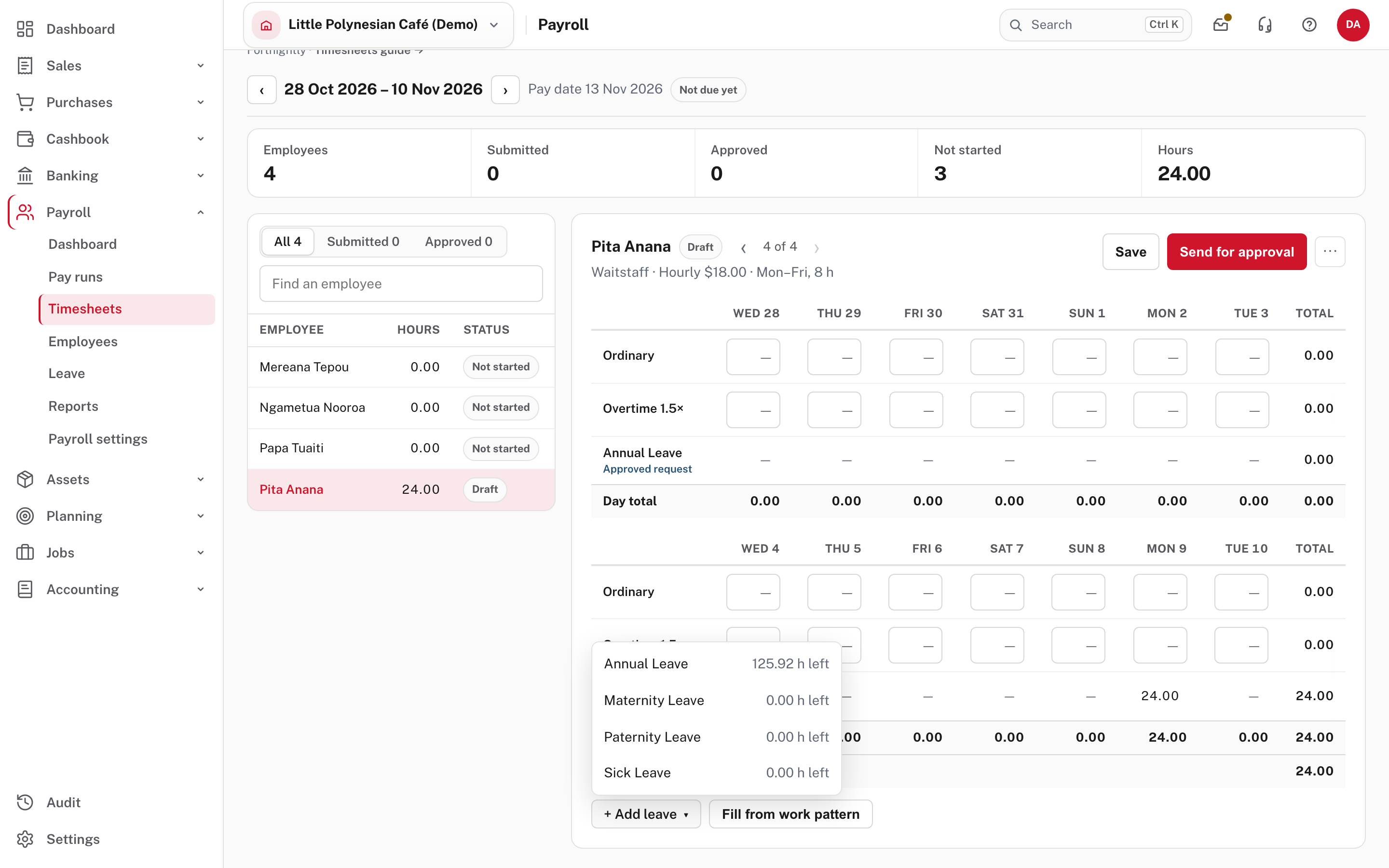
To add leave that has no request, choose + Add leave under the grid. It lists the employee's leave types with the hours each has left; choosing one adds its row, and you type the hours on the days taken.
A day whose hours worked and leave come to more than the person's usual day has its Day total underlined, because the day may be paid twice. If the leave replaces the work, take the hours off Ordinary. (Not shown in the demo: taken from Easy's Help.)
Someone paid their standard pay with no timesheet can have leave added from their payslip in the pay run instead, with Add leave on the payslip (Paid leave in a pay run). (Not shown in the demo: taken from Easy's Help.)
Step 5. Read the balances
Payroll → Leave → Balances.
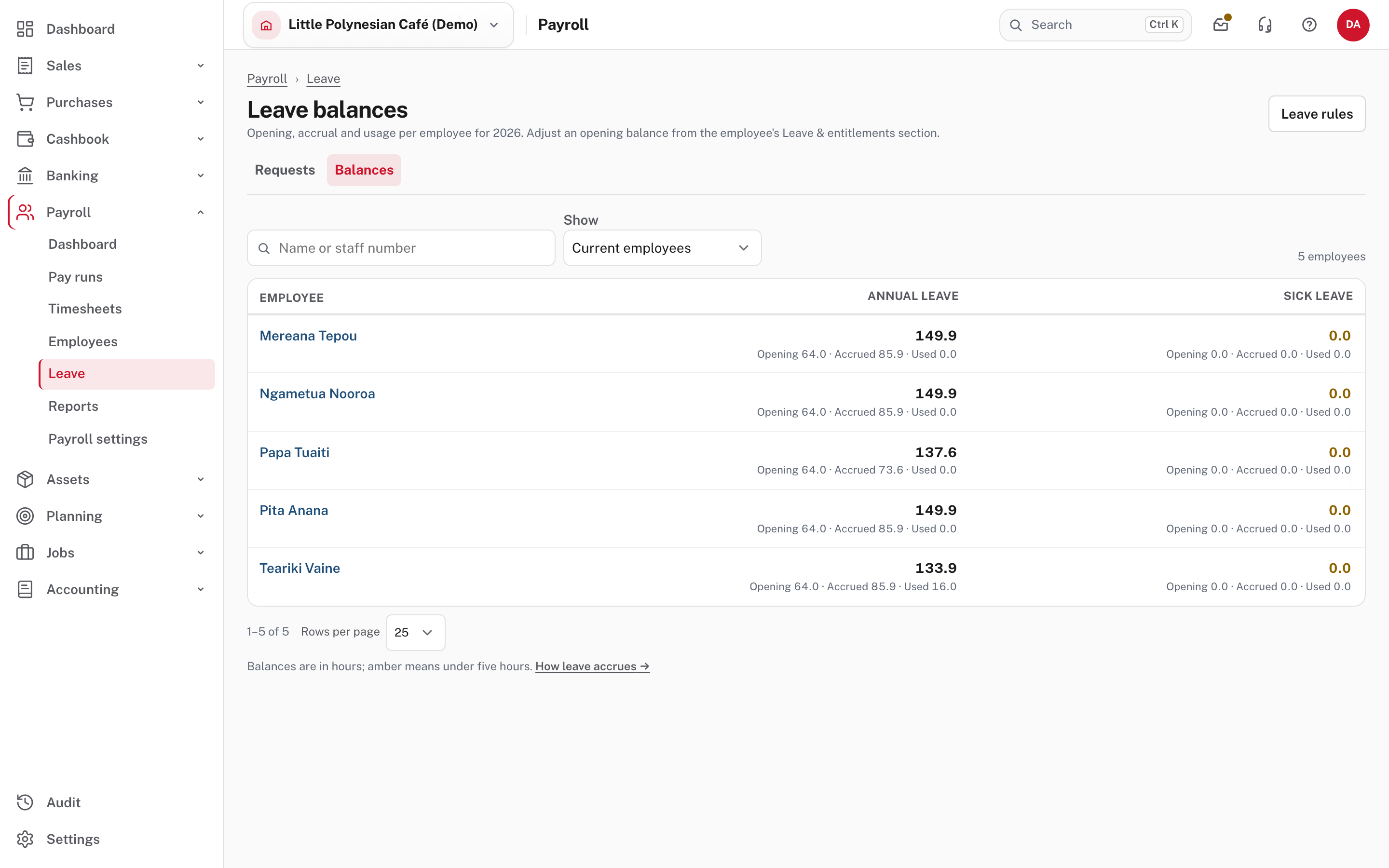
Each employee and leave type shows the balance in hours, with Opening, Accrued and Used beneath. Amber means under five hours. Search by name or staff number, and filter with Show: current employees, low balance, former employees or everyone. Leave that is approved but whose pay run is not finished yet is not in Used: Pita Anana's 24 hours are still reserved, not used. Leave rules (top right) opens the leave types and their entitlements.
How it builds up:
- Accrual. Leave accrues when a normal pay run is finished. A type set to accrue pro rata builds a little each pay period. A type granted on the work anniversary (usually sick leave) gives the whole year's hours at once, on the start date and then on each anniversary. An extra one-off payment does not accrue leave.
- A new year. Balances are kept per calendar year, and each type's Carry unused hours into the next year switch decides what the new year starts with: carry over (usually annual leave), last until next anniversary (sick leave), or reset on 1 January.
- Opening balances. To set where someone starts, use Adjust on their Leave & entitlements section (chapter 1).
- First leave. Months of service before first leave in the leave rules sets a wait before a type can be taken (the Act allows up to six months).
- Time in lieu and special leave. Hours you grant by hand are added from the employee's Leave & entitlements with Grant hours, and correct with Undo (Time in lieu and special leave). (Not shown in the demo: taken from Easy's Help.)
More detail: Leave balances and accrual.
Step 6. What the business owes in leave
Payroll → Reports → Leave liability.
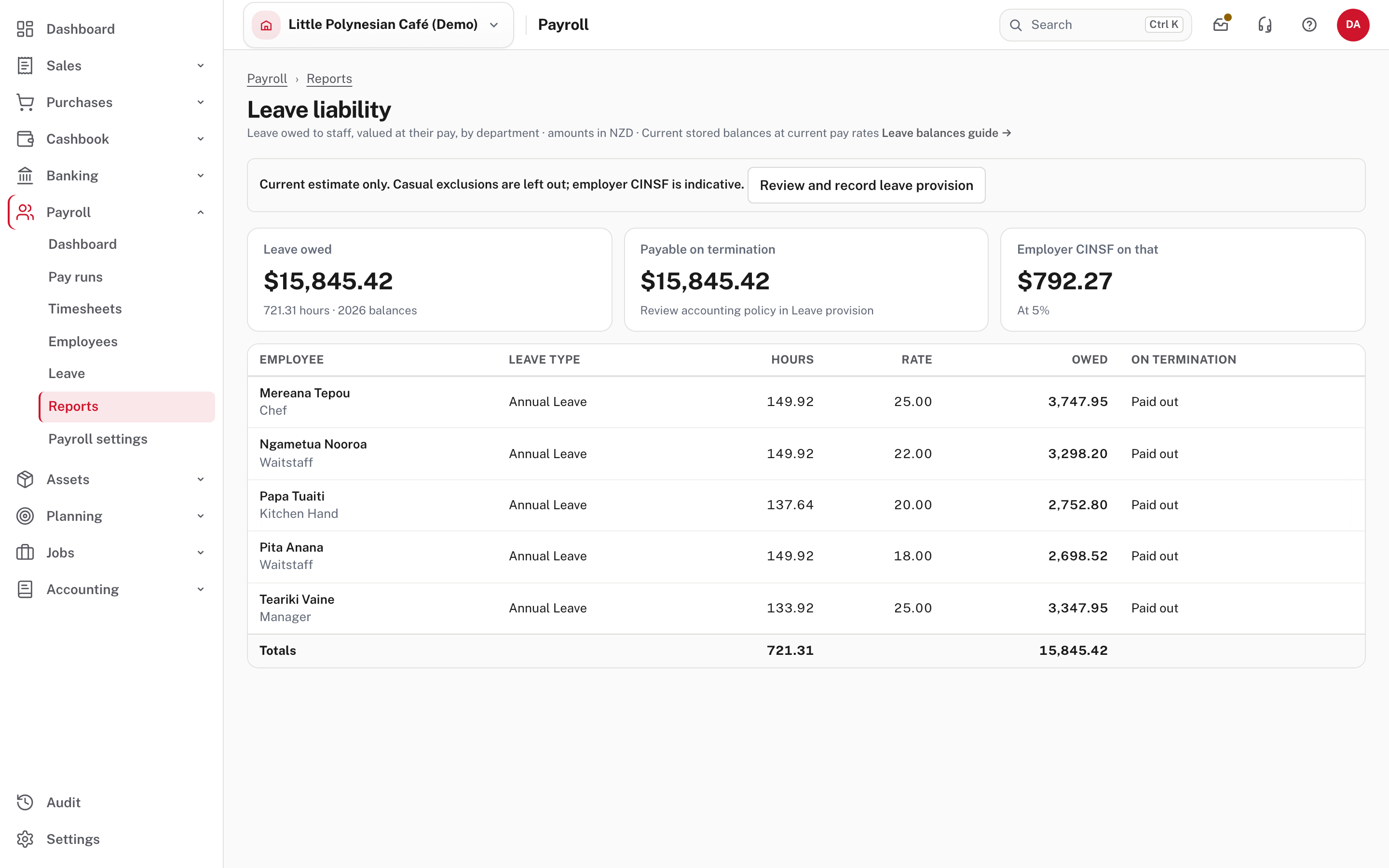
It values every active employee's current balance at their pay (the hourly rate, or the period salary over the ordinary hours) and shows the leave owed, the amount payable on termination, and the employer CINSF on that, with each person's hours, rate and amount owed. It is a current estimate only: casual exclusions are left out and the employer CINSF is indicative. Where employees have a department, it is shown by department first.
To put the amount in your accounts, choose Review and record leave provision. That opens the Leave provision screen, where an accountant reviews the leave owing at a month or year end and records one adjusting journal (After the pay run, step 5).
When someone leaves
Each leave entitlement rule has a Pay out on termination setting. Paid out: the unused balance is cashed out and closed when the employee's final pay run is finished. Forfeited: the balance is lost (sick leave, usually). See Starters, leavers and changes to pay.
Check before you continue
Check before you continue
- Every leave request is entered with the right type, dates and hours, and has been decided.
- Approved leave appears on the timesheet before the pay run is built.
- After the pay run is finished, the balance has come down by the leave taken.
- Balances look right, and no one has an unexpectedly low (amber) balance.
- At month or year end, if your accountant wants it, the leave provision has been reviewed and recorded from Leave liability.